Table of Contents
What just happened
On December 30, 2025, the Department of Homeland Security announced $250 million in FEMA grants for counter-unmanned aircraft systems—the first dedicated federal funding for state and local counter-drone capability in U.S. history.
The grants went to 11 states hosting the 2026 FIFA World Cup and America’s 250th anniversary celebrations: Texas, Florida, New York, New Jersey, California, Georgia, Missouri, Kansas, Massachusetts, Washington, and Pennsylvania, plus the National Capital Region.
FEMA called it the fastest non-disaster grant program they’ve ever run. Applications opened and awards were issued within 25 days.
Then in January 2026, DHS created something even more significant: a permanent Program Executive Office for Unmanned Aircraft Systems and Counter-UAS. Not a temporary task force. Not a pilot program. A permanent institutional office with $115 million earmarked for counter-drone technologies and a $1.5 billion contract vehicle for rapid acquisition.
This isn’t pilot-program money. DHS created a permanent office, FEMA is distributing $500 million across two fiscal years, and a $1.5 billion contract vehicle is active for CBP and ICE counter-drone procurement. The federal government is building counter-drone as a standing capability.
Why this matters right now
Three converging forces make the next 12 months the most consequential window for counter-drone investment in U.S. history.
1. The FIFA World Cup starts June 11
Sixteen cities across the country will host matches through July 19. Each venue needs airspace security. The FY2026 NDAA specifically designates the World Cup (along with the 2028 Olympics) as a pilot program for state and local counter-UAS deployment—the first time state and local agencies have been granted counter-drone mitigation authority.
That’s not just a security requirement. It’s a legal milestone. Until now, only federal agencies had the authority to track, intercept, or disable unauthorized drones. The NDAA framework allows DHS and DOJ to extend that authority to trained state and local operators for major events.
2. FY2027 opens to all 50 states
The second $250 million tranche opens to all 56 State Administrative Agencies—every state, territory, and the District of Columbia. Eligible subrecipients include police departments, emergency management offices, airport authorities, and port authorities. If your state missed the first round, the FY2027 window is your opportunity.
3. The threat is accelerating
The FAA reports over 100 drone sightings near airports per month. Criminal organizations are using drones for smuggling and surveillance along the U.S.-Mexico border. In February 2026, a counter-drone laser deployment near El Paso caused an airspace closure that triggered a Senate investigation into coordination failures between counter-drone operators and civilian aviation.
Europe is further along this curve. Belgium, the Netherlands, and Germany have all experienced drone incursions at airports, military bases, and nuclear facilities. The EU Commission published a formal Counter-UAS Action Plan in February 2026.
The counter-UAS market reflects this urgency: $6.6 billion in 2025, projected to reach $20 billion by 2030—a 25% compound annual growth rate.
| Metric | Value |
|---|---|
| FEMA C-UAS grants (FY2026) | $250M awarded to 11 states |
| FEMA C-UAS grants (FY2027) | $250M open to all 56 SAAs |
| DHS C-UAS office investment | $115M for World Cup security |
| CBP/ICE contract vehicle | $1.5B for counter-drone acquisition |
| C-UAS market (2025) | $6.6B |
| C-UAS market (2030 projected) | $20.3B |
What the grants actually cover
The FEMA Counter-UAS Grant Program funds five specific capabilities, collectively known as DIMT-M:
- Detection—Identifying that a drone is present in your airspace
- Identification—Determining what type of drone it is, who’s operating it, and whether it’s authorized
- Monitoring—Continuously tracking the drone’s position, altitude, speed, and behavior
- Tracking—Following the drone’s flight path and tracing it back to the operator
- Mitigation—Neutralizing the threat through electronic countermeasures, kinetic intercept, or other approved methods
Notice what’s not on this list: buying drones for your own use. These grants are specifically for defending against unauthorized drones. And every one of these five capabilities is fundamentally an AI and software problem.
Why counter-drone is really an AI problem
Most agencies approach counter-drone the way they approached cybersecurity 15 years ago: buy a box, plug it in, hope for the best. That approach fails for the same reason it failed in cybersecurity—the threat evolves faster than static hardware can adapt.
Here’s the reality. A counter-drone system that relies on pre-programmed threat signatures will miss every drone it hasn’t seen before. The drone market is producing new models monthly. Criminal and adversarial operators modify commercial drones to change their RF signatures, remove transponders, and operate in ways that don’t match manufacturer defaults.
Data from the Ukraine conflict illustrates the pace of adaptation: electronic warfare countermeasures require updates every 4 to 6 weeks to remain effective against evolving drone tactics. Adversaries don’t wait for your firmware update cycle.
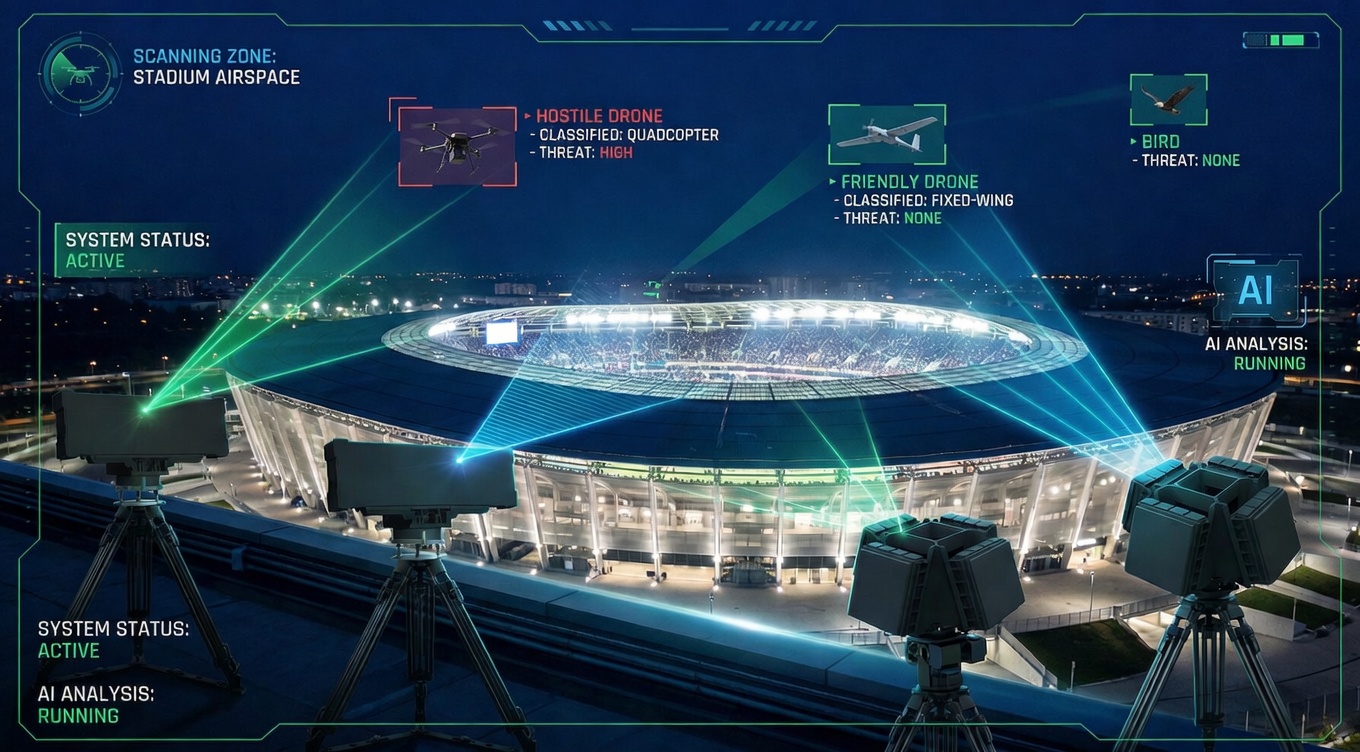
A counter-drone sensor array without AI-powered classification is a very expensive false alarm generator. At airports and stadiums, false positives trigger evacuations, ground flights, and erode public trust. At critical infrastructure sites, they create alert fatigue that masks real threats.
This is why the most capable counter-drone systems being fielded today are AI-native. Phoenix AI, a Belgian defense company, builds edge AI cameras that perform detection, classification, and tracking entirely within the sensor module—no cloud connectivity required, no latency from round-trip data transmission, no single point of failure. The U.S. Army’s 18th Airborne Corps is fielding Legion Intelligence’s Centurion, a deployable edge AI system designed specifically for denied, degraded, intermittent, and limited (DDIL) environments.
The pattern is clear: the hardware detects. The AI decides. And the AI needs to work at the edge—on the device, in real time, without depending on a cloud connection that an adversary can jam or an internet outage can sever.
The 4 AI capabilities agencies need
If your agency is applying for FEMA C-UAS grants or building counter-drone capability with any funding source, here are the four AI capabilities that separate effective systems from expensive shelf-ware.
1. Multi-sensor fusion with AI classification
No single sensor type reliably detects all drones in all conditions. Radar struggles with small, low-flying drones. RF detection misses drones operating autonomously without a control link. Electro-optical cameras fail in poor visibility. Acoustic sensors have limited range.
Effective counter-drone systems layer multiple sensor types—radar, RF, electro-optical, infrared, acoustic—and use AI to fuse their inputs into a unified threat picture. The AI doesn’t just aggregate data. It resolves conflicts between sensors, weights inputs based on environmental conditions, and classifies threats with confidence scores that human operators can act on.
2. Edge processing for real-time response
Counter-drone decisions happen in seconds. A drone approaching a stadium at 60 mph covers 88 feet per second. If your detection data has to travel to a cloud server for AI processing and come back, you’ve already lost the engagement window.
Edge AI—processing intelligence directly on the sensor or on a local compute device—eliminates round-trip latency. Modern edge computing platforms like the NVIDIA Jetson Orin deliver the processing power for real-time computer vision and multi-object tracking within the size, weight, and power constraints of field-deployable systems.
Edge processing also means your system works when connectivity doesn’t. A sophisticated adversary will attempt to disrupt your communications as part of their drone operation. An edge-native system keeps working regardless.
3. Adaptive threat models that learn
Static threat libraries become obsolete the moment a new drone model enters service or an adversary modifies their tactics. AI-powered systems continuously learn from encounters—updating classification models based on new signatures, refining behavioral analysis based on observed flight patterns, and sharing threat intelligence across a distributed sensor network.
This is the capability that scales. A traditional system protects one site with one set of rules. An AI-native system that learns from every encounter across every deployment gets smarter for everyone in the network.
4. Operator decision support, not automation
Counter-drone mitigation—actually neutralizing a drone—has legal, safety, and political implications. The NDAA framework requires trained operators and compliance oversight before any state or local entity can conduct mitigation activities. No responsible agency is going to automate the decision to jam or intercept a drone over a populated area.
What AI should do is give operators the information they need to make fast, confident decisions: threat classification with probability scores, predicted flight paths, operator location estimates, risk assessments for different response options, and clear visual displays that reduce cognitive load under pressure.
The El Paso incident in February—where a counter-drone laser deployment caused an airspace closure and triggered a Senate investigation—illustrates what happens when counter-drone operations lack coordination and decision support. Better AI-driven situational awareness could have flagged the conflict with civilian aviation before the engagement, not after.
The hardware is the easy part
Sensors, radars, and RF detectors are commodity hardware. What separates a $2 million false-alarm machine from an effective counter-drone system is the AI layer: the classification algorithms, the sensor fusion logic, the edge processing architecture, and the operator interfaces that turn raw data into actionable intelligence. That’s software. That’s AI engineering.
What this means for your agency
The $500 million FEMA program is the starting gun, not the finish line. DHS has created a permanent office. The NDAA has established the legal framework. A $1.5 billion contract vehicle is active. The counter-UAS market is growing at 25% annually.
If you’re a state or local agency, the window to build counter-drone capability is open now. The FY2027 grants will be competitive, and agencies that applied in the first round will have a head start. Start planning your DIMT-M architecture now, even if your state wasn’t in the first 11.
If you’re a federal contractor or defense prime, counter-UAS AI is an area where small, specialized firms bring capabilities that large integrators often lack. Edge AI, adaptive threat classification, and DDIL-hardened systems are not commodities you source from the lowest bidder.
If you’re evaluating counter-drone solutions, ask these questions before signing a contract:
- Does the system process data at the edge, or does it depend on cloud connectivity?
- How does the AI handle drone models it hasn’t been trained on?
- How frequently are threat classification models updated, and what triggers an update?
- Can the system operate in a GPS-denied or communications-degraded environment?
- What happens when two sensors disagree about whether an object is a threat?
- Is the system built on an American-made, NDAA-compliant technology stack?
If your vendor can’t answer these questions clearly, you’re buying hardware, not capability.
The organizations that win counter-drone contracts—and the agencies that build effective counter-drone programs—won’t be the ones with the most sensors. They’ll be the ones with the best AI: the classification algorithms that reduce false alarms, the edge architectures that work when connectivity fails, and the adaptive systems that evolve as fast as the threat does.
Building Counter-Drone Capability?
Codavyn is an AI engineering firm specializing in edge-processed drone AI, counter-UAS detection algorithms, and autonomous systems software. American-made. No cloud dependency.
Federal and state contracting? We’re a small business with active SAM.gov registration, CAGE code 1AUN0, and NAICS codes covering AI R&D and engineering services. View our government contracting profile →