
← Back to Blog
NEW MODERNIZATION GUIDE October 1, 2026 · 10 min read

How to Modernize a Legacy System Without a Big-Bang Rewrite

The system that worries you most is usually the one that works. It takes the orders and closes the books, and nobody wants to be the person who switched it off. This is the method we use to replace a platform like that one piece at a time, while the business keeps running on it.

An old server tower glowing amber through its cracks, wrapped by a new lattice of glowing blue and green modules that grows around it like the roots of a strangler fig

Why the big-bang rewrite keeps failing

The usual plan sounds clean. Freeze the old system. Spend eighteen months to two years building its replacement. Pick a weekend, move everything over, and switch the old one off on Monday.

In practice the old system never really freezes. The business keeps asking for changes, so the team maintains two systems and the new one chases a moving target. Requirements live in code nobody has read in years. And the cutover weekend becomes the single moment where everything has to go right at once.

70%
of digital transformations fall short of their objectives (BCG, 2020)
$600B
a year lost to downtime across the Global 2000, up 50% in two years (Splunk and Oxford Economics, 2026)
1 weekend
is all a big-bang cutover gives you to get everything right at once

So the question isn’t whether to modernize. Staying put has its own bill, and old platforms tend to fail at peak load in ways the current team has never seen. The question is how to do it without betting the business on one weekend. The answer is to replace the system in slices, with the old one running the whole time.

The Method at a Glance

Learn It. Sort It. Replace It in Slices.

An assessment turns the old system into facts. Each component gets a decision. The ones worth replacing move one slice at a time, with the old platform running until its last slice is retired.

Step 1

Learn What the System Actually Does

Every modernization that goes wrong starts with the same assumption: we know what this system does. You know what it was designed to do. Over the years it picked up pricing exceptions, regional rules, month-end fixes and integrations that nobody wrote down.

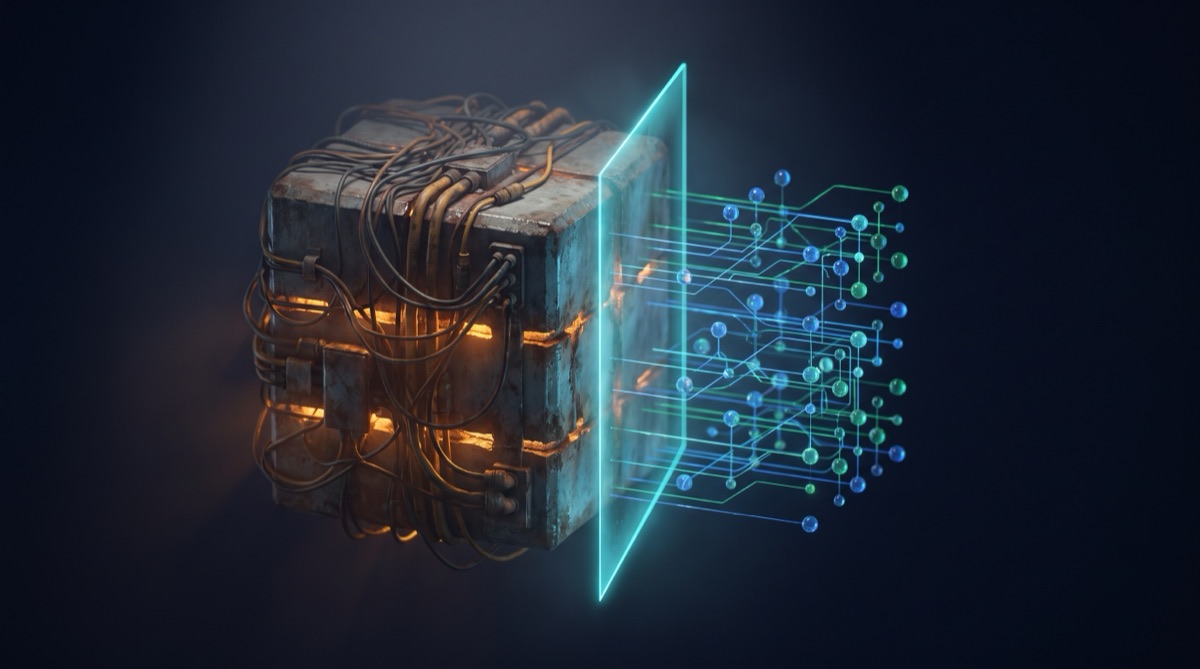
A tangled, amber-lit legacy server block passing through a plane of cyan light and coming out the other side as a clean, orderly map of connected blue and green nodes

A 6 to 10 week assessment. Five outputs.

  • Platform map. Every system that calls this one, every system it calls, and every file, queue and table in between.
  • Business rules catalogue. Pulled out of the code and confirmed by the people who run the process.
  • Controls and risk map. Unsupported components, single points of failure, and the parts only one person understands.
  • Options and a recommendation. Keep, wrap or replace, for each major component.
  • Wave plan. The order the slices move in, with a fixed price for the first ones.

This is where AI has changed the economics the most. Reading old code used to eat the first year of a program. Now a model can read the code, trace the dependencies and draft the business rules in weeks. The scale is already proven inside large companies. Amazon estimates its AI assistant saved 4,500 developer-years upgrading its Java applications (AWS, 2024). In one large Google code migration, AI wrote 80% of the code changes, with engineers writing or editing the rest (Google, 2025).

The rule we hold to

AI does the reading. People make the calls. Every rule the model extracts gets confirmed by someone who knows the business, because a rule nobody has confirmed is still a guess.

Step 2

Decide Keep, Wrap, or Replace

Not everything old needs replacing. Some components are stable, cheap to run and rarely change. Replacing them burns budget and adds risk for no gain. The assessment sorts each major component into one of three buckets.

Keep

Stable and Supported

Rarely changed, not a security exposure, cheap to run. Leave it alone. Document it and monitor it.

Wrap

Sound Logic, No Way In

The logic works but nothing new can talk to it. Put an API in front so new systems can use it without touching its code.

Replace

Holding the Business Back

Expensive to change, unsupported, slowing the roadmap or showing up in audit findings. Rebuild it as a new component, slice by slice.

Wrapping is underrated. An API in front of a stable old component often buys years, and it is also the first move in most replacements. Once everything talks to the API instead of the old code, you can swap what sits behind it without anyone upstream noticing.

Step 3

Pick the First Slice

A slice is one piece of the system that can move on its own: a business capability, a product line, a region, or one type of transaction.

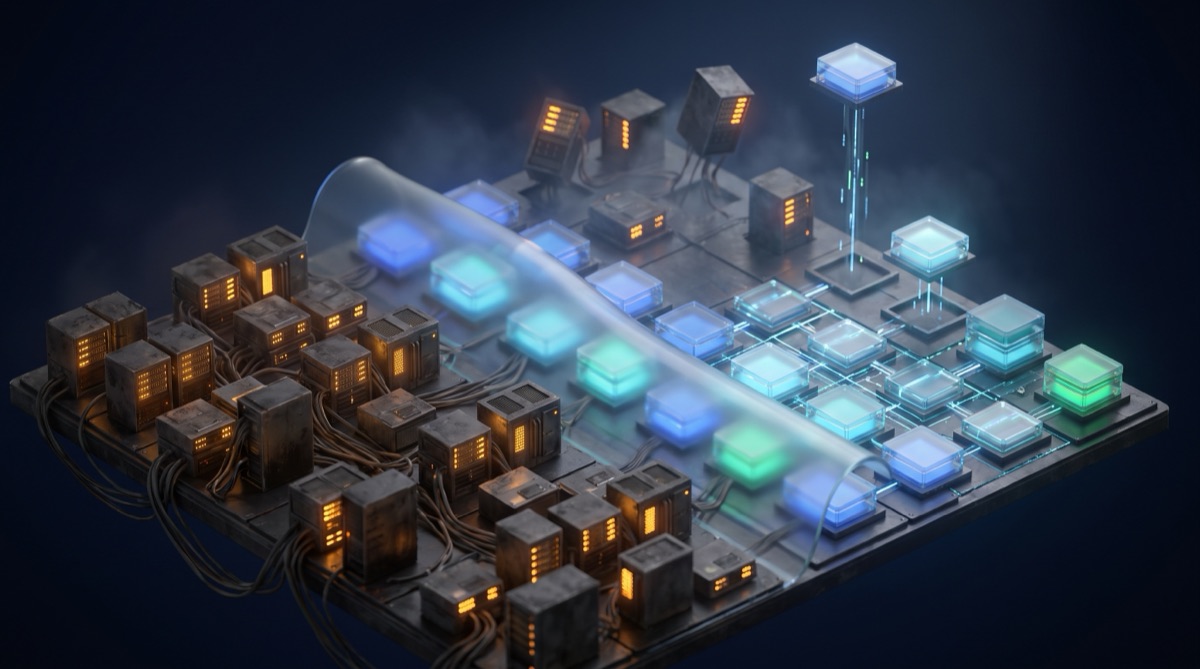
A wide platform of old amber-lit server blocks being replaced block by block by a wave of new glowing blue and green modules, with the old blocks still running ahead of the wave

Costly or risky, and done in a quarter.

  • Pick what hurts. The slice costing the most money or carrying the most risk gets the business’s attention.
  • Keep it small. One that ships in a quarter proves the method before anyone has to bet more on it.
  • Save the tangle for later. The hardest part of the system is where programs go to stall. Take it on with a working pattern and a team that has done it once.
Step 4

Build Beside the Old System

The new component is built next to the running system, not in place of it. This is the strangler fig pattern, named by Martin Fowler after a vine that grows around a tree until it can stand on its own.

A Router in Front

Requests go through a routing layer that decides whether each one goes to the old code or the new component. It is how traffic moves later, one slice at a time.

Done, Defined Up Front

Acceptance criteria for the slice are signed in writing before work starts, so nobody argues about what “done” means at the end.

One Gate for Every Line

Tests, coverage, security scans and license checks run on every change before it merges, whether a person or a model wrote it.

Step 5

Run Both and Explain Every Difference

This is the step most teams skip, and it’s the one that makes the method safe.

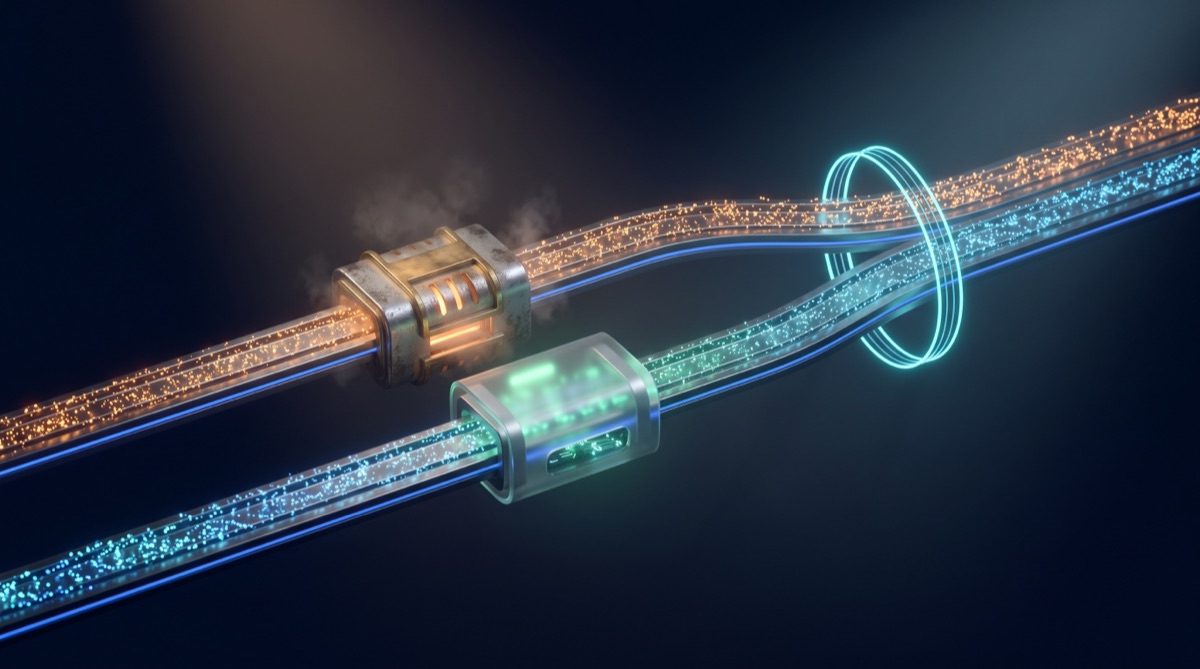
Two parallel tracks carrying the same stream of light particles, one through an old amber module and one through a new green glass module, compared as they pass through a single ring of cyan light

Same traffic. Two systems. Every result compared.

  • Real traffic, both paths. Before the new component takes over, it runs in parallel with the old one on live requests.
  • Every difference gets a name. Some are bugs in the new code. Some are old bugs the business quietly worked around. Some are rules nobody knew existed.
  • A full business cycle. Month-end close, the weekly batch and the busiest day all happen at least once before anything switches.

Why this matters

A parallel run turns cutover from a leap of faith into a decision backed by evidence. By the time traffic moves, the new component has already handled the real workload, and every difference has a name and an owner.

Step 6

Cut Over, Then Retire the Old Piece

Cutover is a routing change, not a weekend war room.

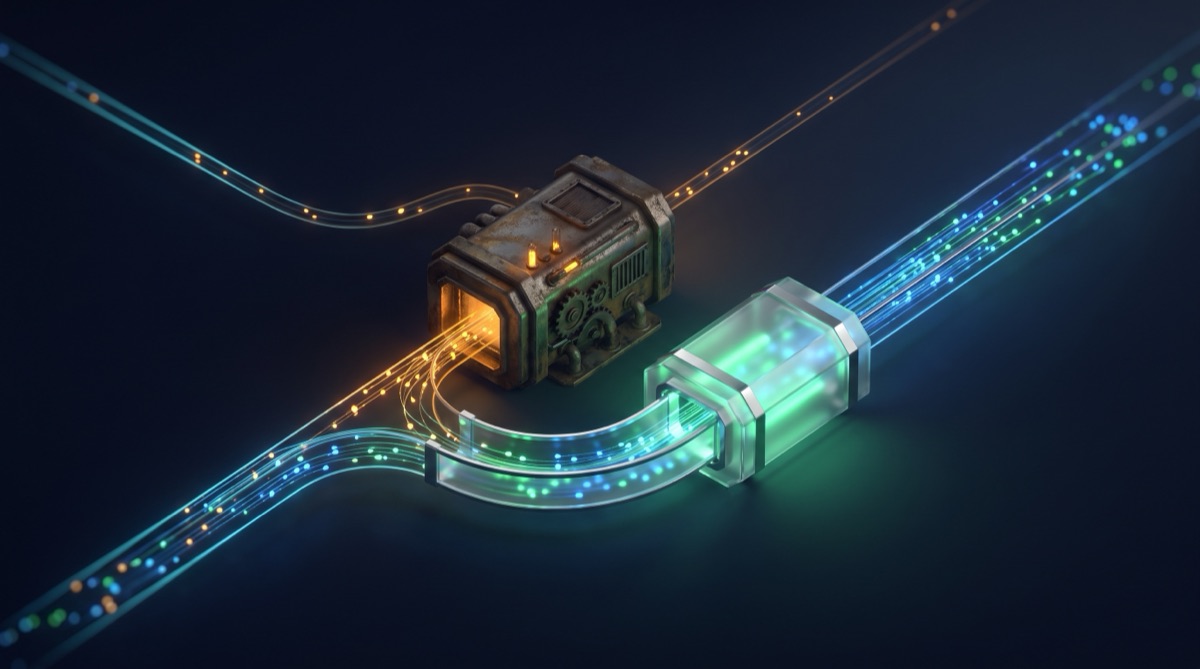
Streams of light rerouted around a dimming old amber module into a new green glass module, with a faint path still leading to the old module on standby

The old path stays on standby.

  • Traffic moves gradually. Often a percentage at a time, watched the whole way.
  • Rollback is one more routing change. Not a rebuild, and not a restore from backup.
  • Then the old piece goes. After an agreed clean run it is switched off, and your team gets the code, docs and runbook for what replaced it.

Two things follow from working this way. You can stop after any slice and keep what you have, because every finished slice is running in production. And the old platform keeps running until its last slice is retired, so the business never goes through a single all-or-nothing moment.

Pricing

How to Put a Fixed Price on It

Many large firms won’t quote a fixed price for modernization. Old code is unpredictable, and nobody wants to price unknowns. The buyer ends up with an open-ended bill and a program with no natural place to stop. The assessment is what changes that: once the dependencies are mapped and the rules are written down, each slice is a known quantity.

  1. 01

    A Fixed Price for the Assessment

    Scoped and priced up front, with the five outputs from Step 1 as the deliverables.

  2. 02

    A Fixed Price per Milestone

    Each slice is priced before work starts and paid when it meets the acceptance criteria you set. If the scope changes, the change is agreed in writing first.

  3. 03

    Your Code, Your Cloud, From Day One

    The code lives in your repository and runs in your cloud accounts. Documentation and runbooks are deliverables, so your team or another firm can take over at any milestone.

Avoid These

Five Mistakes That Stall Modernization

1. Skipping the assessment

Starting to build before the business rules are written down means discovering them in production.

2. Replacing everything

Components that should be kept or wrapped soak up budget the important slices needed.

3. Starting with the hardest slice

The program stalls before it proves anything.

4. Cutting over without a parallel run

The first real test of the new system becomes the moment the business depends on it.

5. Treating AI output as finished work

AI reads code faster than any team. It still needs people who know the business to confirm what it found.

None of this is exotic. It’s a disciplined loop: map, build beside, run both, cut over, retire. What has changed is the cost of the first step. Discovery that used to take a year now takes weeks, which makes it practical to replace a platform the business depends on without betting it on a single weekend.

Have a Platform You Can’t Switch Off?

Tell us which part worries you most. We’ll come back with a fixed scope and price for the assessment, then replace your platform one slice at a time with a fixed price per milestone. See how our legacy modernization services work.

Codavyn

Codavyn

Custom software development and modernization, accelerated by AI.

Continue Reading